
How to Sell Excess Stock in Perth Without Losing Half the Value to Freight
TL;DR: Perth's distance from east-coast markets is the main reason surplus stock sells for less here. The fix is a buyer who quotes on the whole lot and absorbs freight. That's how Stock Solutions works with WA businesses.
The problem with trying to sell excess stock in Perth isn't that nobody wants it. It's that every buyer east of the Nullarbor prices 3,400 km of road freight into their offer before they've even looked at the list.
That's the real cost. Not the discount on the product, the discount on the distance.
Why Perth surplus stock sells for less than the same stock in Melbourne
Two identical pallets of discontinued homewares, one in Welshpool and one in Dandenong. The Dandenong pallet gets three local offers by Friday. The Welshpool pallet gets one, and it's 30% lighter because the buyer has to pay to bring it east.
Perth's local buyer pool is small. Businesses here also tend to over-order to avoid repeat inbound freight, which means excess builds faster and there are fewer people to sell it to. Add mining cycles that turn workwear, consumables and catering stock into surplus overnight, and you get warehouses in Canning Vale and Malaga carrying inventory that hasn't earned anything in a year.
What inventory liquidation looks like when freight isn't your problem
The way around the distance penalty is simple. Find a buyer who moves interstate freight as a normal part of business, so the cost isn't a surprise deduction on your offer.
Inventory liquidation through Stock Solutions works like this. You send a stock list with quantities, condition and expiry dates. We quote on the full lot. Accept, and we book the freight to our Truganina warehouse, collect from your premises and pay on collection. The number on the offer is the number in your account.
If you want the short version of what we buy and how the process runs for WA, the excess stock buyers Perth page covers it.
Liquidation services vs listing it yourself
Marketplaces and auction platforms look free until you do the maths. Listing fees, commission on what sells, storage while it doesn't, and staff time photographing 60 SKUs. Then you've still got the 40% nobody bid on.
Proper liquidation services buy the lot. That includes the awkward stock, because the resale channels exist to move mixed pallets. The trade-off is one offer instead of the fantasy of retail-price sell-through, and for most Perth businesses that trade is worth it by the second month of storage fees.
When to sell liquidation stock instead of holding it
Hold it if it's core range and turnover is just slow this quarter. Sell liquidation stock if any of these apply:
It's been written down on the books
It's short-dated with under 12 months to expiry
It's superseded or discontinued by the manufacturer
It's taking floor space you need for stock that actually moves
It's tied to a project or contract that's finished
Every month you hold stock in that second category, the offer gets smaller. Short-dated product in particular loses value on a fixed schedule.
What surplus inventory liquidation does to your balance sheet
Inventory is money you've already spent sitting on a shelf. Surplus inventory liquidation converts it back into working capital in weeks, and for businesses with a bank facility tied to stock levels it cleans the balance sheet before the next review. Written-down stock that sells for anything at all is a gain against a zero.
Why liquidation specialists beat a category buyer
A category buyer takes the easy SKUs and leaves you the rest. Liquidation specialists take the pallet. That's the difference between clearing a warehouse and clearing a corner of it, and it's the only version that actually solves the problem. Our full range of services covers both sides, buying from suppliers and supplying to retail.
People Also Ask
How do I sell excess stock in Perth without paying freight?
Use a buyer who covers freight as part of the purchase. Stock Solutions quotes on the full lot and arranges transport from Perth metro to Melbourne at no cost to the seller. The offer amount is paid on collection with no freight or handling deductions taken afterward.
What is inventory liquidation?
Inventory liquidation is selling surplus, discontinued or short-dated stock to a third-party buyer in one transaction rather than discounting it through your own channels. The buyer purchases the entire lot, removes it from your premises and on-sells through separate channels, so your regular pricing isn't affected.
Is it worth liquidating written-off stock?
Yes. Stock written down to zero on the books still has resale value if it's unused and in original packaging. Any sale price is a gain against the write-off, and it frees storage space and insurance cost. Discontinued lines and short-dated goods are common examples.
How long does stock liquidation take from Perth?
Quotes typically come back within a few business days of receiving a stock list. After acceptance, pickup from Perth metro is usually arranged within one to two weeks depending on freight scheduling. Payment is made on collection, before the stock leaves Western Australia.
Next step
Put your stock list together with quantities and expiry dates, then head to our Perth excess stock buyers page for what we buy and how to send it through. Or skip straight to contact us with the list attached.
What to Do With Near Expiry Stock Before a Write-Off Is Your Only Option
Six pallets of imported sauce, nine months of shelf life left, and the buyer who committed to it has quietly stopped returning calls. That's how most near expiry stock problems start not with a disaster, just with a forecast that didn't land. And every week it sits in the racking, your options get narrower and cheaper.
Australia throws away more than 7.6 million tonnes of food a year. Around 70 per cent of it is perfectly edible, and the total cost to the economy runs past $36.6 billion (FIAL, National Food Waste Strategy Feasibility Study). A large slice of that never reaches a household bin. It dies in a warehouse, in full cartons, because nobody moved on it in time.
The window closes faster than the date suggests
Here's the part that catches suppliers out. Your date isn't the deadline your customer's receiving policy is.
Most Australian grocery and discount retailers work to a minimum residual shelf life on intake, commonly around 75 per cent of total life for ambient lines, and they'll knock back a delivery that doesn't clear it. So a 12-month product is effectively unsaleable through mainstream retail once it's three months old. Short dated products aren't stock you sell later. They're stock you sell now, through a different door.
Work backwards from that intake rule and you'll usually find you have weeks, not months.
Option one: discount it through your own channels
Cheapest to execute, and it protects the relationship with the customer who ordered it. Run a trade promo, bundle it with a moving line, or hand it to your reps as a volume incentive.
The catch is that you're training your own accounts to wait for the discount. Do it twice on the same line and your standard price stops meaning anything. Fine as a one-off. Dangerous as a habit.
Option two: donate it
Foodbank, OzHarvest and SecondBite will take short dated food that's still safe and correctly labelled, and you get the tax deduction plus a genuine ESG line item.
You don't get cash back. For a small residual quantity that's a clean answer. For a container load with real cost tied up in it, donating the whole lot to avoid a hard conversation with your CFO is an expensive way to feel good.
Option three: write it down and dump it
Under section 70-50 of the Income Tax Assessment Act 1997, a business can elect to value an item of trading stock below cost, market selling value and replacement value where obsolescence or other special circumstances warrant it provided the figure is reasonable. The ATO has also accepted a nil valuation where the stock is dumped or destroyed within a reasonable period after the end of the income year in which it's written down (TR 93/23).
So the write-off is real, and it's legitimate. It's also the worst commercial outcome available to you, because a deduction returns you a fraction of cost while a sale returns actual cash. Talk to your accountant about the treatment but treat destruction as the last option, not the default one. (This is general information, not tax advice.)
Option four: sell the lot to a clearance buyer
This is the one most suppliers reach for too late. Specialist short dated stock buyers purchase the entire line outright, pay on collection, and move the product through secondary channels — discount variety chains, independents, export markets, food service — well away from your primary accounts.
You won't get anywhere near invoice price. What you will get is cash instead of a deduction, empty racking instead of stored dead weight, and the product placed somewhere it won't undercut your own customers.
The earlier you make the call, the better the number. A line with seven months left is a trading proposition. The same line with six weeks left is a logistics problem, and it gets priced like one.
Have this ready before you ask for an offer
Buyers quote faster and higher when the information is clean:
SKU, description, barcode and case configuration
Quantity in cartons and pallets, not units
Best before or use by date per batch
Warehouse location and whether it's palletised and ready to load
Any branding, labelling or channel restrictions you need enforced
Missing dates and unpalletised mixed stock are the two things that most reliably drag an offer down.
FAQ
What counts as short dated stock? Short dated stock is product that still has usable shelf life but not enough to satisfy a retailer's minimum life-on-receipt requirement. In Australian grocery that's commonly around 75 per cent of total shelf life remaining at intake. The goods are safe and saleable — they've just aged out of the mainstream channel.
Can I sell food past its best before date? Best before dates aren't a safety limit. Food can legally be sold after a best before date in Australia provided it's still fit for consumption and not damaged or deteriorated, and many discount channels stock it. Use by dates are different that food can't be sold after the date at all.
How much will a clearance buyer pay? It depends on remaining shelf life, category, brand recognition, quantity and how easily the product moves through secondary channels. Volume with generous dating attracts real competition. Short-dated, slow-category, low-volume lots attract far less. The single biggest lever you control is how early you start the conversation.
Will my stock end up next to my own retail customers? It shouldn't. Reputable buyers agree channel restrictions up front and place goods in markets that don't compete with your existing accounts. Get the restriction confirmed in writing before you commit to the sale.
Sitting on stock right now?
Send Stock Solutions your line list SKUs, carton quantities, dates and location and you'll have an offer back in days, not weeks. Whole pallets or whole warehouses, anywhere in Australia. If you're in South East Queensland, excess stock buyers Brisbane covers local collection.
End of Season Stock Clearance: Your Options and What You'll Actually Get Paid
February arrives and the summer range is still on the pallet. You over-ordered by 30 per cent, the season ran short, and now you're paying to store product that won't sell again for ten months. Every option on the table costs you something. The question is which one costs least.
Most businesses answer that question far too slowly, and the delay is what does the damage.
Holding it gets more expensive than people calculate
The instinct is to store it and sell it next season at full margin. Sometimes that's right. Usually the maths says otherwise.
Warehousing on a pallet rate, the working capital locked in the stock, insurance, shrinkage and handling add up quietly across ten months. Add the real risk that next season's range makes this one look dated, that packaging changes, that a colourway falls out of favour and "hold it" stops being the free option it feels like.
Run the number before you default to it. If carrying cost plus risk exceeds what a clearance buyer would pay today, holding is a decision to lose money slowly.
Marking it down in your own channel
The obvious move, and the one with the sharpest hidden edge.
Seasonal stock clearance through your own store, site or trade accounts recovers more per unit than any other route. It also teaches your customers exactly when to wait. Run an aggressive end of season clearance two years running and you'll watch full-price sell-through drop in year three, because the market has learned your calendar.
There's a version of this that works: shallow, short, and framed tightly. Deep discounting your entire remaining range publicly is a different thing, and it prices your brand as much as it prices the stock.
Selling the lot to a clearance buyer
Selling excess stock as a single parcel to a specialist buyer trades margin for speed and certainty. You get one price for the lot, one collection, cash on pickup, and the goods move through channels that sit away from your own discount chains, independents, export, closed-door clubs, online liquidators.
This is the route worth understanding properly, because the number you're offered isn't arbitrary.
How a liquidation stock offer is actually built
Buyers work backwards from what they can resell it for, then subtract everything between here and there. The main inputs:
Sell-through speed. Broad-appeal, everyday product beats niche. Size-curve-heavy apparel with only odd sizes left prices badly.
Season timing. Winter stock offered in March is worth more than the same stock offered in July, because the buyer can place it this year rather than warehouse it for twelve months.
Quantity and consistency. A clean single-SKU pallet quote is quicker and stronger than 400 mixed lines with no counts.
Brand. Recognisable brands move faster, but they also come with more channel restrictions, which cuts the buyer's options.
Condition and packaging. Original cartons, saleable retail packaging, no store stickers, no damage.
Your restrictions. Every geographic or channel limit you impose narrows resale and comes out of the price. Sometimes that's worth paying for. Just know you're paying for it.
Expect a fraction of wholesale. What you're really buying is liquidity, cleared space and a clean line in the stocktake.
Protecting your pricing while you clear
You can control most of the brand risk contractually. Ask for it up front:
Written channel restrictions which retailers or marketplaces the goods can't appear in
Geographic restrictions, if you're protecting a distributor territory
Delabelling or debranding for the deepest-discount channels
No resale back into your own customer base
Confirmation of where the goods are actually going before you sign
A serious buyer will agree to these in writing. One who won't is telling you something.
What to have ready
SKU list with descriptions, quantity by carton and pallet, RRP and cost, photographs, warehouse location, and whether the stock is palletised and ready to load. Supply that and you'll get a firm offer quickly. Supply "roughly 200 boxes of last summer's range" and you'll get a low, hedged number, because the buyer is pricing their own uncertainty.
FAQ
When should I start an end of season stock clearance? Before the season ends, not after. Buyers price on how quickly they can place the goods, so stock offered while there's still selling season left attracts stronger competition. Waiting until the range is a full season out of date typically costs you a significant share of the offer.
What's the difference between clearance and liquidation stock? Clearance usually means discounting surplus through your own channels at reduced margin. Liquidation stock means selling the parcel outright to a third-party buyer who takes ownership and resells it elsewhere. Clearance recovers more per unit; liquidation recovers cash faster and doesn't train your customers to wait for markdowns.
Will clearing excess stock damage my brand? Only if you don't control the channel. Agreed restrictions on where goods can be resold, plus delabelling where needed, keep discounted product away from your primary customers. The bigger brand risk is usually repeated public discounting in your own store, not a controlled third-party sale.
Do I have to sell the entire lot? No. Most buyers will quote on part of a range, though whole-lot parcels usually attract better pricing because they're cheaper to handle. If you want to keep core sizes or colours back for next season, say so when you send the lists it changes the number.
Got a range to move?
Send Stock Solutions your line list with quantities, dates and location, and you'll have a firm offer back within days. National coverage, whole-lot purchase, cash on collection. South East Queensland businesses can go straight to excess stock buyers Brisbane for local pickup, and if the issue is dating rather than season, start with short dated stock buyers.
How Australian Retailers Source Discounted Branded Stock

Margin pressure is real for Australian retailers right now. Costs are up, consumer spending is cautious, and the standard wholesale channel is offering roughly the same terms it always has.
The retailers managing this well aren't doing anything exotic. A portion of their inventory — the portion that drives their strongest margin lines — comes through the liquidation stock market. Branded product, quality assured, priced below what their competitors paid through normal wholesale channels.
It's not a secret. It's just a sourcing channel most retailers haven't formalised yet.
Why the Liquidation Market Exists for Retail Buyers
Liquidation stock reaches the market for straightforward commercial reasons. A supplier overcommits on a promotional range. A retailer returns a parcel. A product line gets discontinued and the old SKU needs to clear. A seasonal range misses its window.
None of that has anything to do with product quality. The stock is real, branded, and saleable. It just needs a path to market outside the supplier's normal channels — and that path runs through specialist brokers like Stock Solutions, who assess it, verify it, and make it available to buyers at below-wholesale pricing.
For a buyer, that gap between what they pay and what they can sell it for is margin. Pure and simple.
What Retail Buyers Actually Source Through the Liquidation Channel
The categories moving through the Australian liquidation stock market cover more ground than most retailers expect.
Grocery and FMCG is consistently the highest-volume category — promotional carryover, short-dated lines, and discontinued ranges from national brands. For independent grocery retailers, this channel regularly produces branded product at prices that support margins well above their standard wholesale lines.
General merchandise — branded homewares, seasonal product, sporting goods, cleaning, and household — moves through regularly and suits the ranging strategies of discount variety retailers and independents alike.
Health and beauty surplus is available across cosmetics, personal care, and wellness categories. For pharmacies, health retailers, and beauty independents, sourcing through the liquidation market supplements regular stock with high-margin branded product.
One independent retailer we work with regularly — sourcing across grocery and general merchandise categories — has built the liquidation channel into their standard buying cycle. They contact us with category and volume requirements at the start of each month. We match them to available stock as it comes through. They've told us the margin on their liquidation-sourced lines consistently outperforms their standard wholesale buying, and the product quality has never been a concern because every parcel is assessed before it reaches them.
That's not a lucky outcome. That's what a formalised sourcing relationship with the right broker produces.
How to Start Sourcing Liquidation Stock as an Australian Retailer
The practical starting point is simpler than most retailers expect.
Register your buying interest: Tell a specialist broker — Stock Solutions, in this case — what categories you buy in, what volumes make sense for your business, and any specific product requirements. That buying profile sits in the network and gets matched to stock as it becomes available.
Don't wait for a perfect parcel: The retailers who get the most from the liquidation stock market are the ones who engage with available stock consistently, not the ones holding out for an idealised parcel at an idealised price. The market moves. Buyers who respond quickly to available stock access better pricing than those who take weeks to decide.
Treat it as a channel, not a transaction: One parcel is useful. An ongoing sourcing relationship with a broker who knows your buying profile produces a consistent margin advantage over time. That's the real opportunity — not the one-off deal.
People Also Ask
Where do Australian retailers buy discounted branded stock?
The primary channel for discounted branded stock in Australia is the liquidation market — accessed through specialist brokers who source surplus, overstock, and end-of-line product from suppliers and make it available to buyers at below-wholesale prices. Stock Solutions operates this way nationally, across FMCG, grocery, general merchandise, and health and beauty categories.
Is liquidation stock good quality for retail resale?
When sourced through a reputable broker, yes. A legitimate stock liquidation broker assesses every parcel before it reaches buyers — verifying condition, quantity, dating for relevant categories, and product provenance. The product is surplus because of the supplier's commercial circumstances, not because of product quality issues. Buyers should always confirm the assessment process before purchasing.
How much margin can retailers make on liquidation stock?
Margin depends on the category, the price paid through the liquidation channel, and what the retailer sells it for. In high-demand categories — branded FMCG, grocery, and general merchandise — buyers sourcing through a specialist broker regularly achieve margins above their standard wholesale buying. The margin advantage compounds over time as the buyer builds an ongoing sourcing relationship and accesses stock earlier in the available window.
Want Consistent Access to Discounted Branded Stock?
Tell us what you're buying — categories, volumes, and any specific requirements. Stock Solutions matches Australian retailers and wholesale buyers to quality surplus stock as it comes through our supplier network.
👉 Let's Talk Stock — Get in Touch Today
Surplus Grocery and FMCG Stock: How Suppliers Clear Lines Without Brand Damage
Nobody talks about the clearance that went wrong.
The supplier who moved a significant volume of surplus grocery stock quickly ticked that box, cleared the warehouse, reported the write-down as smaller than expected, and then spent the next six months fielding calls from their major retail partners asking why their product was sitting on a discount shelf at 40% below trade price.
We've had that conversation at Stock Solutions more than once. Every time, the supplier says the same thing: "We just needed it gone."
That instinct, the need to move fast and close the problem, is exactly what creates a bigger one.
Why FMCG Brand Damage Happens During Stock Clearance
The mechanics are straightforward. Surplus FMCG stock moved to the wrong buyer ends up in the wrong channel. The wrong channel means a discount retailer with a national or regional footprint, visible pricing, and no particular incentive to keep your product away from the eyeballs of your existing retail partners.
Your major grocery account sees your product on a competitor's shelf at a price that undercuts what they paid for it last month. Now you have a ranging conversation you didn't plan for, a promotional funding negotiation that went sideways, and a buyer who is, at best, sceptical about your pricing integrity going forward.
The surplus stock moved. The problem didn't.
What Controlled FMCG Stock Clearance Actually Looks Like
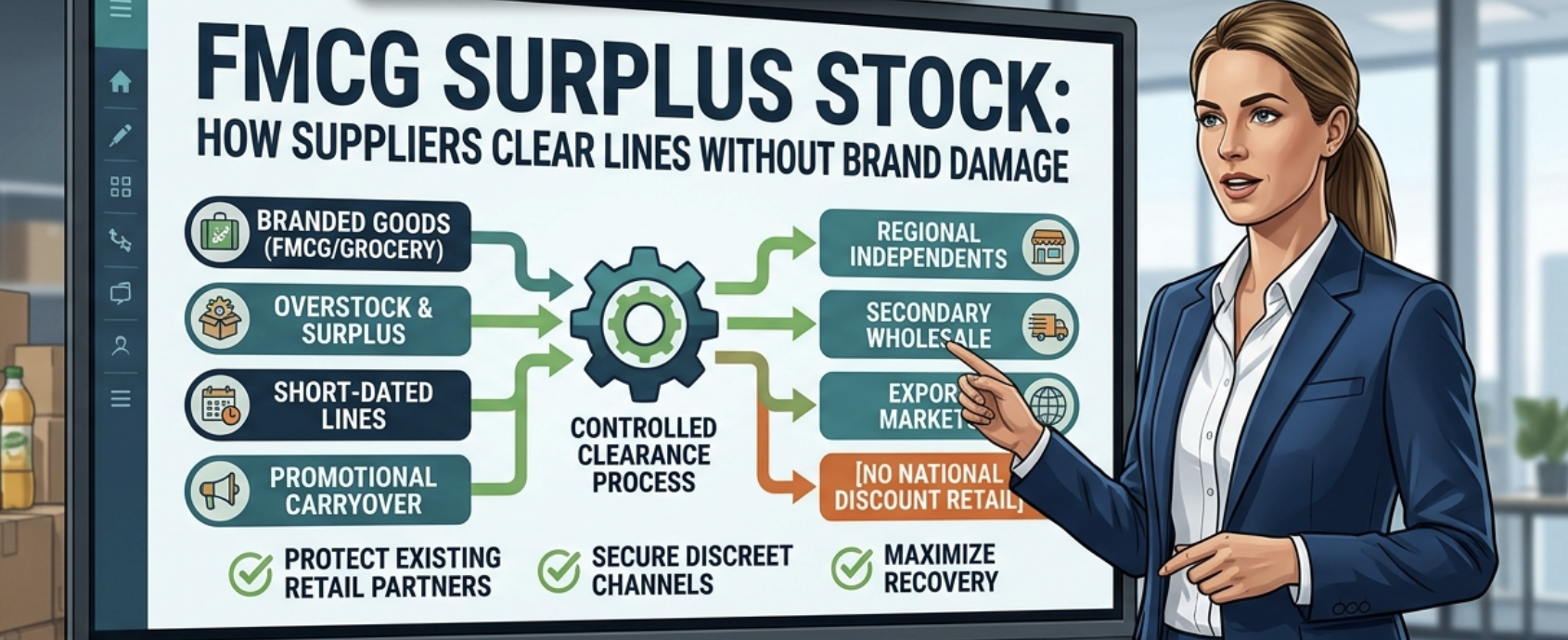
Here's what a well-managed grocery surplus clearance does differently. It starts with the buyer network, not the stock.
Before a single pallet moves, the right clearance partner asks: which buyers are appropriate for this brand in this category? Not who will take it, but who should take it. The distinction matters. Regional independents, export buyers, and secondary wholesale channels can absorb significant FMCG surplus volumes without creating the price visibility that national discount retail does.
A grocery supplier we worked with at Stock Solutions had a substantial volume of promotional carryover, specifically a well-known branded range in excellent condition with healthy dating. The temptation was to move it quickly through the first buyer who responded. Instead, we segmented the parcel, identified three buyer channels that operated completely outside the supplier's primary retail market, and moved the stock simultaneously across all three.
The stock cleared in under two weeks. The supplier's major retail account never saw the product at a discounted price. There was no ranging conversation and no awkward call from a category manager. Just a cleared warehouse and a recovery that came in above the initial single-buyer quote.
The Question Every FMCG Supplier Should Ask Before Clearing Stock
Do not ask, "How fast can we move this?" Ask it differently: "Where will this product be visible, and to whom?"
If you can't answer that question about your clearance partner's buyer network, you don't have enough information to make the decision. A specialist stock liquidation broker should be able to tell you, specifically, which categories of buyer your stock will reach and which it won't.
If the answer is "whoever offers first," that's not a clearance strategy. That's a brand risk waiting to activate.
Our [excess stock clearance guide] covers how a controlled clearance process works and what to look for in a clearance partner. For further industry reading, explore our [FMCG Excess Inventory Guide] or learn why protecting your bottom line matters in [Surplus Stock: Don't Lose Money]. For FMCG-specific questions regarding categories, minimum quantities, and timing, the [FAQ hub] has direct answers.
People Also Ask
How do I sell surplus grocery stock without damaging my brand?
Work with a stock liquidation specialist who controls buyer channel access, not just buyer volume. The brand risk comes from surplus product appearing in retail environments your existing partners can see. A broker with a segmented buyer network moves surplus FMCG stock through channels that don't create price visibility in your primary market.
What happens to surplus food stock in Australia?
Depending on condition and dating, surplus grocery stock moves through discount wholesale buyers, independent retailers, export channels, or, for genuinely unsalvageable product, responsible disposal. A specialist clearance partner assesses each parcel and routes it to the most appropriate channel. The goal is maximum recovery without brand exposure.
Can short-dated grocery stock still be sold in Australia?
Yes, short-dated FMCG stock in good condition with genuine remaining shelf life has an active buyer market in Australia. The buyer pool narrows as dates tighten, so earlier clearance consistently produces better recovery. Stock approaching but not past its best-before date is not unsaleable; it simply requires the right buyer channel and timeline.
Got FMCG Surplus That Needs to Move Cleanly?
Stock Solutions works with Australian grocery and FMCG suppliers to clear surplus lines quickly, discreetly, and through buyer channels that protect your brand positioning. Start with a stock assessment today.
Let's Talk Stock — Get in Touch Today
Liquidation Stock for Sale in Australia: How the Buying Process Works
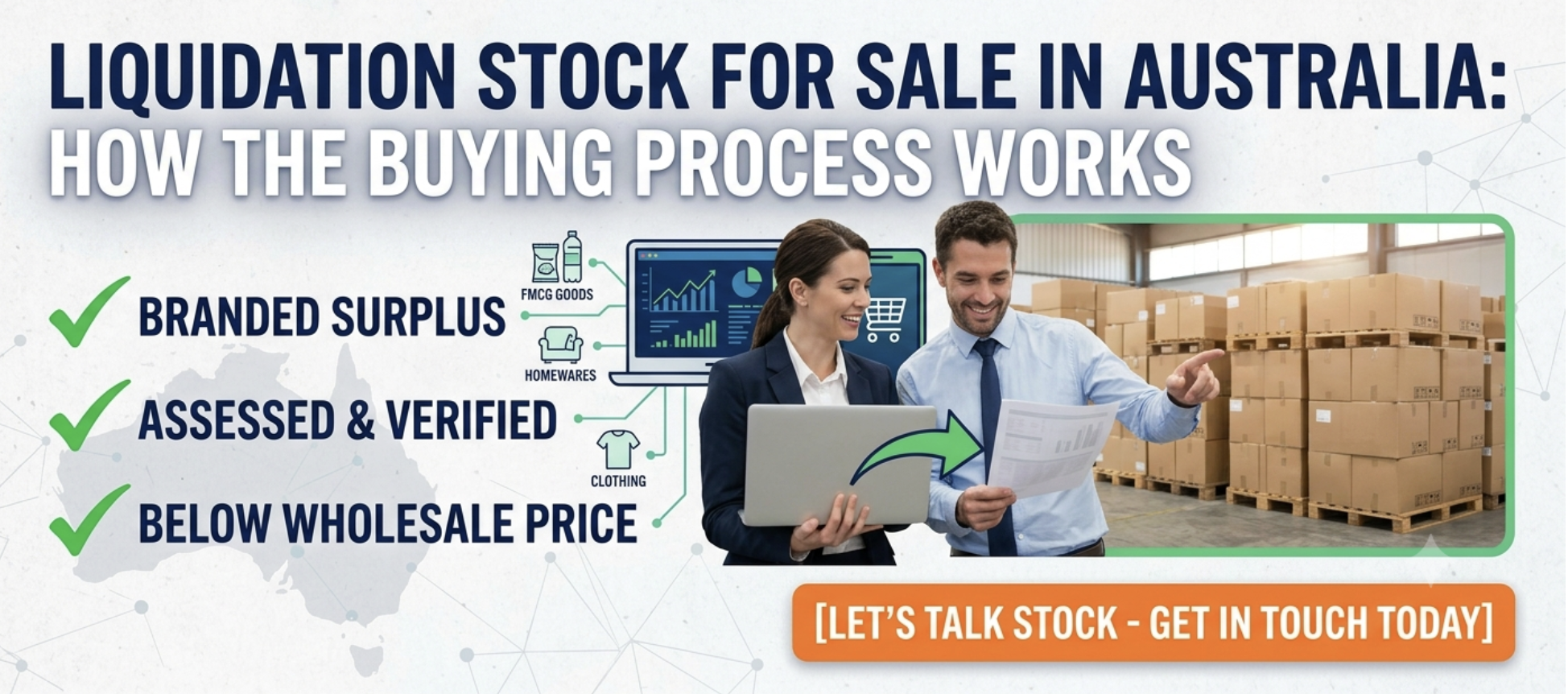
If you're sourcing liquidation stock in Australia for the first time, the process isn't what most people expect.
It's not an auction. It's not a warehouse full of unsorted mystery pallets. And it's not a single transaction; it's a sourcing relationship that, done right, gives your business consistent access to branded product at margins your competitors buying through normal wholesale channels can't easily match.
Here's exactly how it works.
What Liquidation Stock Is Actually Available in Australia?
More than most buyers realise. The liquidation stock market in Australia draws from a wide range of supplier situations, with each producing different product types and conditions:
FMCG and grocery surplus: Overstock, promotional carryover, or short-dated lines from national suppliers.
General merchandise: Branded homewares, sporting goods, seasonal product, cleaning, and household items.
Health and beauty: Cosmetics, personal care, and wellness product at below-wholesale prices.
Apparel and accessories: End-of-line clothing and footwear at wholesale volumes.
Cancelled order stock: Product manufactured or imported for an order that didn't proceed, often in pristine condition.
The common thread: this is real branded product with genuine commercial value. It's surplus because the supplier's circumstances changed, not because the product is defective or unsaleable.
How Do You Source Liquidation Stock Through a Broker?
Through Stock Solutions, the process is direct.
Step 1: Tell us what you're looking for. Specify your target category, volume, and any unique product requirements. We match buyer needs to stock as it comes through our supplier network. Knowing what you're actively sourcing means we can contact you the moment the right parcel becomes available.
Step 2: Stock assessment. Every parcel that comes through Stock Solutions is fully assessed before it reaches buyers. We verify condition, quantity, dating (where relevant), and category alignment. You're never sorting through unseen product hoping for value; you know exactly what you're buying before you commit.
Step 3: Pricing and offer. Liquidation stock is priced below wholesale, creating a healthy margin gap for buyers. Pricing reflects the specific category, condition, volume, and current market demand. Buyers who move quickly on available stock consistently secure the best pricing.
Step 4: Movement and logistics. Stock is collected or delivered depending on volumes and logistics. Stock Solutions coordinates the movement, ensuring the buyer receives the stock in the exact condition and quantities confirmed during the assessment stage.
What Should Buyers Look for in a Liquidation Stock Supplier?
Three things separate a reliable liquidation stock source from a problematic one.
1. Provenance
You should know where the stock came from, why it's in the liquidation market, and who the original supplier was (at least at a category level). Stock with clear provenance is tradeable stock. Mystery pallets with no origin story present a compliance and reputational risk.
2. Condition Verification
A reputable broker assesses stock before it reaches buyers. If you're being offered liquidation stock for sale with no condition information, no dating confirmation for food and health categories, and no way to verify what you're buying, that's a red flag rather than a bargain.
3. Consistency of Supply
One parcel is a transaction. A relationship with a specialist broker is a sourcing channel. The buyers who get the most value from liquidation stock in Australia are the ones who establish an ongoing supply relationship, not those chasing one-off deals.
For more on what Stock Solutions offers buyers specifically, our Buy Liquidation Stock Australia page covers categories, processes, and how to enquire. Common buyer questions are also answered directly in our emails/ Want to learn more about retail strategies? Contact us now.
People Also Ask
Is it legal to buy and sell liquidation stock in Australia?
Yes. Buying and selling liquidation stock is entirely legal in Australia. Stock purchased through a reputable broker comes with full provenance: origin supplier, condition assessment, and compliance verification for regulated categories. Buyers should ensure they are sourcing through a legitimate broker rather than unverified channels, particularly for food, health, and regulated product categories.
How much below wholesale is liquidation stock priced?
Pricing varies by category, condition, volume, and timing. Liquidation stock in high-demand categories (like branded FMCG, grocery, and general merchandise in good condition) typically moves at a meaningful discount to standard wholesale pricing, supporting strong buyer margin. Short-dated or high-volume parcels may move at deeper discounts. The best way to understand current pricing is to register your buying interest with a specialist broker.
Can small retailers buy liquidation stock in Australia?
Yes. While some liquidation parcels are priced for wholesale volumes, specialist brokers like Stock Solutions work with buyers across a range of scales, from independent retailers sourcing single-category parcels through to large-volume wholesale buyers. The key is communicating your volume requirements and category interests upfront so stock can be matched appropriately.
Looking for Liquidation Stock to Source Regularly?
Stock Solutions works with Australian retailers and wholesale buyers to provide consistent access to quality branded surplus that is assessed, verified, and priced for buyer margin. Tell us what categories and volumes you're looking for.
Surplus Grocery and FMCG Stock: How Suppliers Clear Lines Without Brand Damage
TL;DR: Clearing surplus FMCG or grocery stock in Australia requires strict channel control. To avoid upsetting major supermarket partners, suppliers must bypass public discount channels and route excess inventory through closed, secondary buyer networks.
For fast-moving consumer goods (FMCG) and grocery suppliers, inventory management is a high-stakes race against the calendar. Best-before dates tick down, packaging designs change, and promotional forecasts don't always match actual supermarket scan data.
When you find yourself holding a significant volume of surplus stock, the pressure to clear warehouse space is intense. However, a reckless clearance move can easily inflict long-term damage on your brand. If your premium product suddenly surfaces on a discount shelf or public online marketplace at a fraction of its standard trade price, it creates immediate, severe price tension with your core retail partners.
Fortunately, there is a proven playbook for clearing bulk grocery inventory safely. Here is how leading Australian suppliers protect their brands while recovering valuable working capital.
1. Avoid the Trap of the Public Markdown
When dealing with a minor overstock, using on-page copy, bundle deals, or standard stock clearance strategies on your own channels is perfectly fine.
But when you are holding pallets of bulk inventory, public discounting is dangerous. Major Australian retail chains monitor the market closely. If they see your products heavily discounted in public secondary channels, it undermines your category positioning and complicates future trade negotiations. For true FMCG volume, the clearance process must happen completely behind closed doors.
2. Enforce Strict Channel Restraints
The secret to brand protection during an FMCG clearance event is channel control. You need absolute certainty regarding where your stock will land.
Professional inventory partners don't just sell to the highest bidder; they utilize highly restricted, secondary buyer networks. This includes routing stock to:
Independent regional retailers
Corporate catering and hospitality providers
Closed-loop staff discount stores
Approved export markets entirely outside of Australia
By restricting the inventory to these specific segments, you ensure the products are quietly consumed without cannibalizing your primary domestic supermarket sales.
3. Move Before the Date Becomes Critical
The financial recovery curve for surplus groceries drops off sharply as products near their expiry dates.
The 3-to-6-Month Window: This is the sweet spot. Buyers across secondary networks are highly competitive for branded FMCG items with healthy dates, driving up your recovery value.
The Last-Minute Window: If you wait until a product has less than a month of shelf life, your options vanish. At that point, you risk a total write-off and expensive commercial disposal costs.
Proactive decision-making is the ultimate form of brand protection. The faster you act, the more control you retain over the distribution process.
Protect Your Brand and Clear Your Warehouse
Managing surplus grocery and FMCG inventory doesn't have to mean compromising your hard-earned retail relationships or taking an outright loss.
At Stock Solutions, we specialize in helping Australian suppliers discreetly and efficiently move bulk inventory. We enforce strict brand protections so you can free up capital without disrupting your primary market.
Have questions about our process, accepted categories, or minimum pallet quantities? Check out our comprehensive FAQ hub for fast answers, or contact Stock Solutions today to get a confidential assessment of your stock.
Stock Clearance vs. Stock Liquidation: What’s the Difference?
TL;DR: Stock clearance is a front-facing retail strategy used to move slow items to your existing customers. Stock liquidation is a back-end supply chain solution that moves bulk, problematic volume completely out of your primary market through a specialist network.
If you are holding excess inventory in your warehouse, you need it gone. But how you choose to move it determines how much cash you recover and whether you accidentally damage your brand in the process.
Two terms are constantly thrown around in the supply chain world: stock clearance and stock liquidation. While they sound identical on paper, they represent entirely different strategies, channels, and financial outcomes.
Here is exactly how they differ and how to choose the right path for your business.
What is Stock Clearance?
Stock clearance is typically a front-facing, internal retail strategy. It is the process of discounting slow-moving or end-of-season inventory directly to your existing customer base or through your established retail channels.
The Goal: To free up shelf space or warehouse slots for incoming seasonal lines.
The Execution: You maintain control of the sale. Think "End of Financial Year" events, flash sales, or on-page markdowns.
When it Applies: This is a supporting term and an excellent option for minor overstocks or standard seasonal transitions. It belongs in your day-to-day page copy and FAQ strategies rather than as a standalone emergency process.
What is Stock Liquidation?
Stock liquidation is a back-end corporate solution designed for bulk, urgent, or problematic inventory that cannot or should not be sold to your regular customers.
When you enter a formal stock liquidation process, you work with a specialist broker to sell large volumes of stock to a closed network of secondary buyers such as discount wholesalers, corporate barter firms, or independent exporters.
The Goal: Immediate capital recovery and total warehouse relief for major asset blocks.
The Execution: The inventory is completely removed from your primary supply chain to ensure it never cannibalizes your core retail relationships.
When it Applies: This is your primary strategy for major brand changes, product reformulations, massive distribution center cleanouts, or short-dated grocery lines.
The Core Differences at a Glance
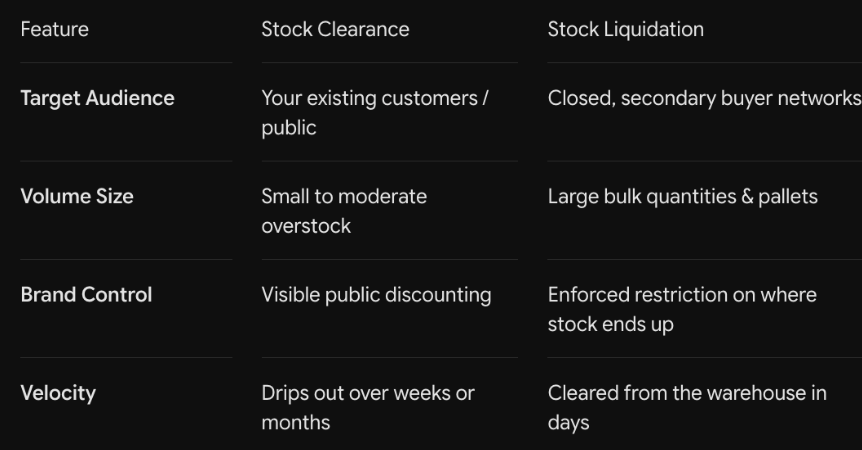
How to Choose the Right Strategy
Choosing between these two paths comes down to a simple assessment of your volume and your brand risk.
Choose Stock Clearance if:
You only have a few pallets or cartons of a slow-moving SKU.
Publicly discounting the product won't upset your major retail partners.
You have the time to let the stock sell down naturally over a few weeks.
Choose Stock Liquidation if:
You are sitting on significant volume that is suffocating your warehouse capacity.
Selling the items cheaply online would destroy your premium brand positioning or violate trade agreements.
You need a guaranteed, single-transaction cleanout to recover cash immediately.
Need a Structured Warehouse Cleanout?
If your inventory has outgrown a simple promotional sale, a structured liquidation keeps your brand safe while maximizing cash return.
At Stock Solutions, we specialize in helping Australian suppliers navigate complex inventory challenges. Explore our tailored excess stock clearance solutions to see how we safely redirect bulk inventory through secure secondary channels, or reach out to our team today to request a rapid stock assessment.
Excess Stock Clearance Australia | Your Options Explained
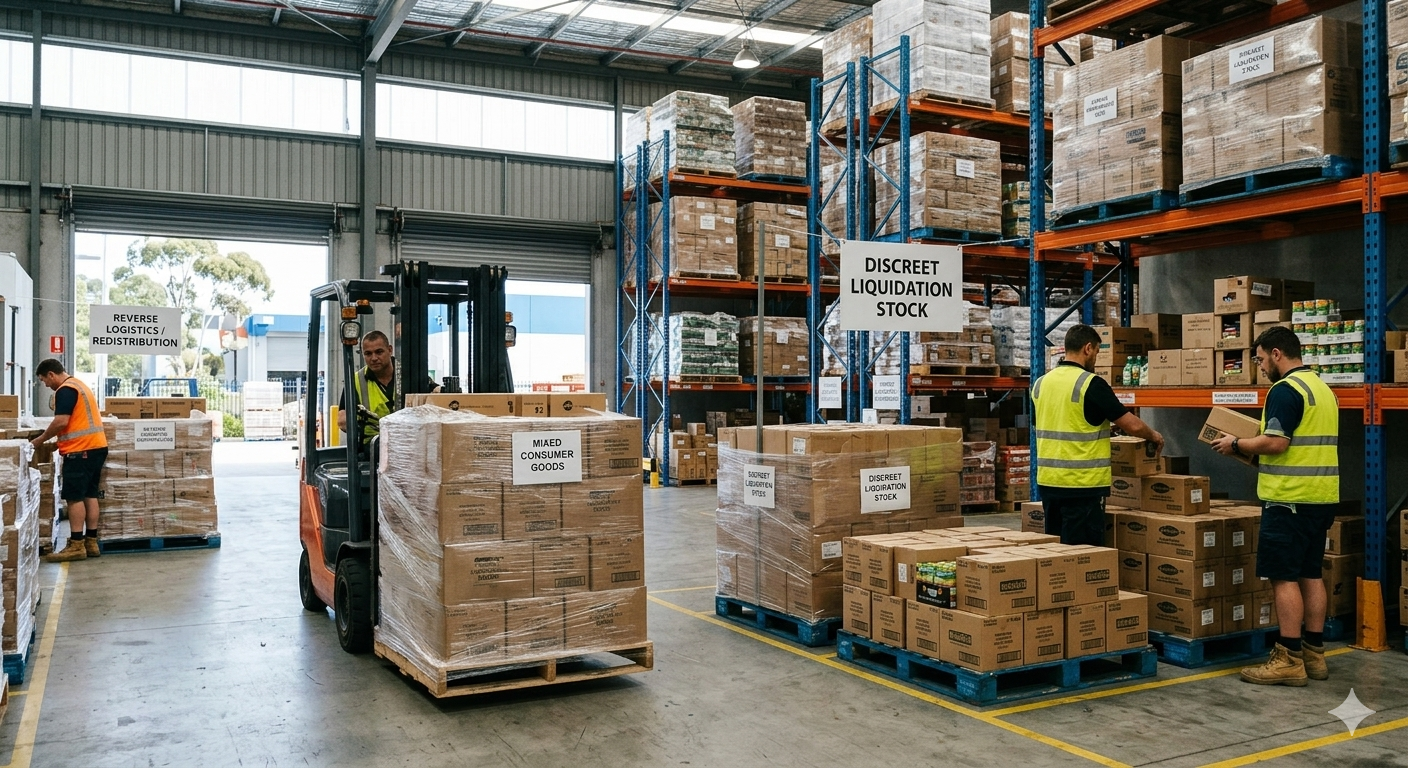
Got excess stock in Australia? Here are your practical clearance options: what each one involves, what it recovers, and when to use it.
TL;DR: Australian suppliers have four main options for clearing excess stock each with different speed, recovery, and brand-risk profiles. Choosing the right one depends on your timeline, your category, and how much control you need over where your stock ends up.
Excess Stock Clearance Australia: What Are Your Options as a Supplier?
Four options. Here they are, straight.
Excess stock clearance in Australia isn't a one-size-fits-all decision. The right route depends on what you're holding, how much time you have, and what a bad outcome actually costs your business. Get the match wrong and you either leave money on the table or create a brand problem that outlasts the clearance event. Here's how each option works.
Option 1: Liquidation Through a Specialist Broker
This is the most structured route. A stock liquidation specialist comes in, assesses what you've got, segments it by category and condition, and moves it through an established buyer network. Not a single buyer, multiple buyers, competing for your product. That competition matters more than most suppliers realise.
Recovery value tends to be the strongest here, particularly if you're not under acute time pressure. When buyers are competing, prices get pushed up from the floor rather than down from your ask. That's a meaningful difference.
Best for significant volumes of FMCG, grocery, or branded general merchandise where brand protection matters and handing everything to one direct buyer creates too much risk. Worth noting this isn't an instant solution. A structured liquidation takes a few days to set up properly. But that setup time is exactly what produces the better outcome.
Option 2: Direct Sale to a Discount Buyer
Faster to kick off. Simpler to execute. And almost always the lowest-recovery option of the four.
When you go direct to a single buyer, you remove the competition that keeps prices honest. The buyer knows they're the only call you've made and the offer they put forward reflects that. We've seen suppliers accept direct offers that were well below what the same stock fetched through a multi-buyer process. Not because the buyer was being dishonest. That's just how single-buyer negotiations work. You've already shown your hand.
Best for small volumes, categories where brand exposure is low, or situations where speed genuinely has to win over recovery.
Option 3: Reverse Logistics and Channel Redistribution
Not every excess stock situation needs the stock to leave your supply chain entirely. If you're holding an overstock that's in solid condition and well within date, redistribution through alternate retail or wholesale channels can recover near-full value without the discount that liquidation implies.
This is as much a reverse logistics decision as it is a clearance one. It needs a partner who can properly assess stock conditions, identify the right channels, and physically manage the movement. For a full breakdown of how this fits into the clearance picture, the What Is Reverse Logistics guide covers the process end to end.
Best for premium branded stock where discounting would create visible price tension with your existing retail relationships.
Option 4: Write-Off and Disposal
This is what happens when businesses don't act. Stock that isn't cleared eventually reaches a point where no buyer channel will touch it date-expired, damaged, or too far past its commercial window to move.
Disposal is sometimes the right call. For genuinely unsalvageable stock, it's the only call. But for the vast majority of excess stock clearance situations in Australia, disposal is value destruction that a proper clearance process would have avoided.
And here's the thing most suppliers don't want to hear: most write-offs aren't inevitable. They're the result of waiting too long to make a decision.
Which Option Is Right for Your Stock?
The short version:
Volume is significant and brand matters: go with a specialist liquidation broker. Speed is the only priority and brand risk is low. Go directly to a buyer. Stock is in great condition with healthy dates and look at redistribution through reverse logistics. Stock is genuinely unsalvageable; disposal is your only move.
For specific questions about how Stock Solutions handles each of these scenarios minimum quantities, categories, timelines, and process the FAQ hub answers the most common supplier questions directly.
People Also Ask
What is excess stock clearance in Australia? Excess stock clearance is the process of moving surplus, overstock, or end-of-line inventory out of a warehouse through sale, liquidation, or redistribution, recovering cash value before the stock declines further. In Australia, specialist brokers manage this process for FMCG, grocery, and general merchandise suppliers across national buyer networks.
How quickly can excess stock be cleared in Australia? It depends on the category, volume, and route chosen. High-demand categories branded FMCG, grocery, general merchandise in good condition can move within days through an established buyer network. A specialist clearance partner will give you a realistic timeline after an initial stock assessment. Rushing without that assessment usually costs recovery value.
Does clearing excess stock damage my brand? It can if the wrong channels are used. Excess stock that appears in visible discount retail at prices below your standard trade terms creates price tension with your existing retail partners. A specialist stock liquidation broker controls where stock goes, moving it through buyer networks that don't cannibalise your core market. Brand protection is a core part of a well-managed clearance.
Not Sure Which Clearance Option Fits Your Situation?
Start with a conversation. Stock Solutions works with Australian suppliers to assess stock, recommend the right clearance route, and execute it without the write-off or the brand risk.
Let's Talk Stock? Get in Touch Today
How to Sell Surplus Stock in Australia Without Losing Money
Here's an uncomfortable truth about surplus stock clearance in Australia.
The moment a buyer knows you're under pressure, the offer drops. Every time. It doesn't matter how good your stock is, how strong the brand is, or how reasonable your expectations are. Urgency is a negotiating position — and when you're the one holding excess inventory with a warehouse bill climbing in the background, you're already negotiating from the wrong side of the table.
Most suppliers know this. Most do it anyway.
Why the "Just Move It Fast" Instinct Costs You More Than You Think
Speed feels like the solution when excess stock is sitting in a warehouse. And yes — stock that isn't moving is costing you money every week. That part is real.
But here's the thing: panic-driven clearance almost always recovers less than a structured sale that takes two extra days to set up properly. We've seen this play out repeatedly. A supplier with a significant volume of short-dated FMCG lines took the first offer from a single discount buyer — a number that felt acceptable under time pressure. A near-identical parcel of stock, cleared through multiple buyer channels with competing interest, recovered materially more. Same product. Different process.
The stock didn't change. The leverage did.
What Actually Protects Your Recovery When Selling Surplus Stock?
Three things. None of them complicated.
Create buyer competition, not buyer convenience
A single buyer with no competition has every incentive to offer less. Multiple buyers with visibility of the same stock parcel have every incentive to move quickly and price fairly. The mechanism is simple. The discipline to slow down and create it — when your instinct is to just accept the first offer — is where most suppliers lose money.
Separate your stock before you price it
Not all surplus stock is equal, even within the same warehouse. Short-dated lines, overstocked lines, and end-of-range lines have different buyer pools and different value profiles. Bundling everything together and pricing it as a single lot almost always means the best stock subsidises the worst. Segment first. Price each category on its own merits.
Control where your stock goes
This matters more than most suppliers realise — especially for FMCG and grocery brands. Surplus stock that ends up in the wrong discount channel, priced visibly below your standard trade terms, creates a brand problem that outlasts the clearance event. A specialist excess stock clearance partner controls the buyer network. Your stock moves through channels that don't cannibalise your core business.
When Is the Right Time to Clear Surplus Stock?
Earlier than feels comfortable. Every time.
The suppliers who recover the best value from stock liquidation are the ones who make the call before the pressure becomes acute. Before the warehouse is full. Before the best-before dates are genuinely tight. Before the retail window has definitively closed.
Waiting for certainty — waiting until you're completely sure the stock won't move through normal channels — is what turns a manageable clearance situation into a fire sale. The market reads your timeline. Price accordingly.
What this actually means for most suppliers: if you're asking the question "should we look at clearing this stock?", the answer is almost certainly yes, and the time is almost certainly now.
For a breakdown of your clearance options — liquidation, structured sale, reverse logistics — the [excess stock clearance guide] lays out exactly when each approach makes sense.
People Also Ask
How do I sell surplus stock in Australia without damaging my brand? Work with a specialist who controls where your stock goes. The risk to brand equity comes from surplus product appearing in visible discount channels at prices that undercut your standard trade terms. A stock liquidation broker with an established buyer network moves stock discreetly — through channels that don't create price tension with your existing retail relationships.
What is the best way to get rid of excess inventory quickly? The fastest route isn't always the most profitable one. The best approach combines speed with competition — getting your stock in front of multiple buyers simultaneously rather than negotiating with one buyer at a time. A specialist excess stock clearance partner does this by default. Going direct to a single buyer is faster to initiate but almost always slower to optimise.
How much is surplus stock worth in Australia? It depends on category, condition, volume, and timing. FMCG and grocery surplus in good condition with reasonable dating moves at better values than most suppliers expect — particularly when cleared early and through the right channels. The worst outcomes come from stock cleared late, in bulk, to a single buyer with no competition. An assessment of your specific stock is the only way to get a realistic number.
Got Surplus Stock Sitting in a Warehouse?
The best time to have this conversation is before the pressure is on. Stock Solutions works with Australian suppliers across FMCG, grocery, and general merchandise — assessing stock, creating buyer competition, and clearing lines without the brand damage or the write-off.
What Is Stock Liquidation? A Plain-English Guide for Australian Suppliers
Let's skip the jargon.
Stock liquidation is what happens when a business decides that holding onto surplus inventory costs more than moving it — and takes deliberate steps to convert that stock into cash. Not someday. Now.
TL;DR: Stock liquidation is the process of converting surplus, excess, or end-of-line inventory into cash — quickly, and without letting it rot in a warehouse. For Australian suppliers, it's one of the most practical tools for clearing stock that's stopped earning its keep.
We see this play out constantly with Australian suppliers. A promotional run overdelivered on volume but underdelivered on sell-through. A retailer returned a pallet — or ten. A product line got reformulated and the old SKUs are suddenly stranded. The stock is real, the warehouse space is real, and the carrying cost ticks upward every single week.
Liquidation is the structured way out.
What Kinds of Stock Get Liquidated?
More than most people assume. Stock liquidation isn't just for businesses in trouble. Some of the most organised, well-run suppliers in Australia use it as a routine inventory management tool. Common categories include:
Excess and overstock — ordered or produced above what the market absorbed
End-of-line and discontinued products — ranges being replaced or reformulated
Short-dated stock — food, health, and beauty products approaching but not past their best-before date
Customer and retailer returns — goods that came back in sellable condition
Seasonal carryover — stock that missed its selling window
What links all of these is the same core problem: the stock has value, but it's not moving through normal channels. Liquidation finds it a new path.
How Does Stock Liquidation Actually Work in Australia?
Here's the honest version — because the process looks different depending on who you work with.
The DIY approach means approaching buyers directly. One at a time, negotiating individually, hoping the first offer is reasonable and that the buyer doesn't lowball because they know you're under pressure. We've spoken to suppliers who went this route and left significant money on the table — not because the stock wasn't good, but because they had one option in front of them and a deadline behind them.
Working with a stock liquidation specialist like Stock Solutions changes the dynamic. Your stock gets assessed, categorised, and matched to the right buyers across an established network — not just the first buyer who picks up the phone. That competition for your stock, even in a liquidation context, consistently produces better outcomes.
One grocery supplier we worked with recently cleared a substantial volume of short-dated FMCG lines through multiple buyer channels simultaneously. The final recovery was meaningfully higher than the single-buyer quote they'd received before reaching out to us. The difference was simply having more than one option.
Is Liquidation the Same as Giving Stock Away?
No. And this misconception costs suppliers money.
Liquidation done well is a managed sale at a realistic market price — not a fire sale. The goal is maximum recovery, not minimum effort. Short-dating, condition, brand, and category all affect the outcome. A specialist handler knows which buyers will pay more for which stock, and routes accordingly.
What this actually means is: the price you recover through a structured liquidation process is almost always better than a panicked direct sale to whoever happens to be available.
For a side-by-side comparison of your clearance options — including when liquidation is the right call versus other approaches — the FAQ hub breaks it down in plain terms.
People Also Ask
What is the difference between stock liquidation and stock clearance? Stock clearance typically refers to discounting and selling through existing retail or wholesale channels — the stock stays in the same market, just at a lower price. Stock liquidation usually means moving stock outside normal channels entirely, through specialist buyers or a liquidation broker. Clearance keeps the stock visible to your existing customers; liquidation moves it discreetly and quickly to a different buyer network.
How much do you lose in a stock liquidation? It depends heavily on the category, condition, volume, and timing. Stock liquidated early — before it becomes short-dated or the market moves — recovers significantly more than stock cleared under deadline pressure. Working with a specialist who has access to multiple buyers, rather than a single direct buyer, also materially improves the outcome.
How do I liquidate excess stock in Australia? The practical starting point is an assessment of what you have — quantities, condition, category, and any compliance considerations. From there, a stock liquidation specialist can advise on the best route to market and give you a realistic recovery estimate. Stock Solutions handles this across FMCG, grocery, general merchandise, and more — the Stock Liquidation page has the full details.
We work with Australian suppliers across FMCG, grocery, and general merchandise to clear excess inventory quickly and cleanly — without the write-off. If you've got stock sitting in a warehouse that's stopped earning its keep, let's have a conversation.
Let's Talk Stock — Get in Touch Today
What Is Reverse Logistics and Why It Matters for Australian Businesses
Reverse logistics is not a complex concept. It just has a complicated name.
Here's what it actually means: when goods move backwards through a supply chain — from a retailer back to a supplier, from a warehouse back to a liquidator, from a customer back to a brand, that's reverse logistics. It's the process of recovering value from stock that didn't sell, got returned, or reached the end of its planned shelf life.
TL;DR: Reverse logistics is the process of moving goods back through the supply chain — from customer or retailer back to the supplier or a specialist handler — to recover maximum value. For Australian businesses sitting on returns or excess stock, it's the difference between a write-off and a recovery.
What Does Reverse Logistics Actually Cover?
Reverse logistics covers more ground than most people realise. It's not just handling customer returns. The full scope includes:
Excess and overstock clearance — stock that was ordered or produced in volumes that outpaced demand
End-of-line stock management — clearing product ranges that are being discontinued or reformulated
Returns processing — sorting, assessing, and redistributing goods that have come back from retailers or end consumers
Recalled stock handling — managing product recalls in a way that minimises waste and cost
Damaged goods recovery — identifying what can be salvaged, resold at a discount, or responsibly disposed of
For Australian FMCG brands and retailers, the most common trigger is overstock. A promotional run that didn't shift as planned. A seasonal range that didn't move. A range reformulation that leaves the old SKUs stranded in a warehouse. These situations don't fix themselves. They get more expensive the longer they sit.
Why Is Reverse Logistics Growing So Fast in Australia?
Three things are happening at once.
Ecommerce returns are climbing. Online retail has expanded significantly across Australia, and with it, return rates. Categories like apparel, health, and general merchandise see return rates that can reach 20–30% of sales. Every one of those returns needs to be processed, assessed, and routed somewhere. That's a reverse logistics challenge.
Retailers are tightening terms. Where once a supplier could negotiate a slow sell-through with a retail partner, many chains are now returning unsold stock — or declining to take it in the first place — at a much faster rate. The excess lands back with the supplier. It needs to move.
Supply chain disruption has left stock in the wrong places. The last few years produced warehouses full of goods that arrived late, arrived in volumes tied to demand forecasts that didn't hold, or arrived into a market that had moved on. Clearing that stock efficiently requires a structured reverse logistics process — not an ad hoc phone call to a discount buyer.
Reverse logistics ecommerce is emerging as its own category. Platforms, technology, and specialist operators have developed specifically to handle the reverse flow that online retail generates. It's one of the fastest-growing corners of the Australian logistics market.
How Does Reverse Logistics Work in Practice?
The process varies depending on the type of stock and the outcome you're trying to achieve. But here's how a structured reverse logistics engagement typically unfolds for an Australian supplier.
Step 1 — Stock Assessment
The process starts with understanding what you have. Quantities, condition, category, packaging integrity, and any compliance considerations (especially relevant for food, health, or regulated product categories). A specialist handler needs this information to route stock appropriately and give you a realistic value recovery estimate.
Step 2 — Route-to-Market Decision
Not all excess stock should go the same way. Some can be sold through wholesale and discount retail channels at near-full value. Some suits a liquidation sale to a buyer network. Some may need to be bundled and cleared in volume. Getting this decision right — matching the stock to the right channel — is where working with a stock liquidation specialist pays off over going direct to a single buyer.
A real example: a national grocery supplier recently found themselves with a significant volume of surplus FMCG lines after a promotional range was discontinued. Rather than approaching a single discount retailer and accepting whatever price was offered, they engaged Stock Solutions to assess the stock, segment it by condition and category, and move it through multiple buyer channels. The outcome was materially better than a single direct sale would have produced. That's the structural advantage of a specialist reverse logistics partner.
Step 3 — Movement and Clearance
Once the route is decided, stock moves. This might mean collection from a warehouse, transfer to a distribution point, or direct buyer access depending on the volumes and logistics involved. A good specialist handles the coordination — the supplier or retailer doesn't need to manage multiple buyer relationships, negotiations, and movements.
Step 4 — Recovery and Reporting
At the end of the process, you get a clear picture of what was recovered. Not just a number — a breakdown of what moved, through which channel, and at what value. This feeds back into smarter forecasting on the forward supply chain. Businesses that track their reverse logistics outcomes get better at avoiding excess stock situations in the first place.
What's the Difference Between Reverse Logistics and Stock Liquidation?
They're related but not the same thing.
Reverse logistics is the broader process — the system for managing the backwards flow of goods across a supply chain. It includes assessment, routing, movement, and recovery.
Stock liquidation is one of the possible outcomes within that process. It's the act of converting excess or surplus stock into cash — typically through sale to a specialist buyer or buyer network, often at a discount to the original retail or wholesale value.
Think of reverse logistics as the strategy. Liquidation is one of the tools within it.
If you want a deeper breakdown of how liquidation works specifically, the guide to covers the process, what stock qualifies, and how to get maximum value when clearing a line.
Does Reverse Logistics Make Financial Sense for Australian Businesses?
The question most suppliers ask is: am I going to get anything meaningful back?
The honest answer is: it depends on the stock. But here's what's certain — the alternative to a structured reverse logistics process is almost always worse.
Stock sitting in a warehouse costs money every month. It occupies space, ties up working capital, and in categories with a shelf life — food, health, beauty, seasonal — it declines in value the longer it sits. The question isn't whether you can afford to move it. It's whether you can afford not to.
A well-managed clearance — whether through liquidation, discount channels, or a structured stock sale — recovers value that a write-off does not. And it clears the decks for new stock, new ranges, and a cleaner balance sheet.
For buyers, the reverse flow creates real opportunity. Liquidation stock that moves through a specialist broker arrives with provenance — verified, assessed, and ready to trade. Retailers sourcing discounted branded stock through this channel get better outcomes than chasing ad hoc surplus at the dock.
How Does Stock Solutions Handle Reverse Logistics?
Stock Solutions operates as a specialist stock liquidation and reverse logistics broker in Australia, working with both sides of the market. Suppliers bring excess, overstock, end-of-line, and returned goods. Buyers — independent retailers, discount chains, wholesale buyers — source those goods through Stock Solutions' buyer network.
The model works because it matches the right stock to the right buyer at the right time. It's not a single transaction. It's a managed process that gets suppliers a better outcome than a direct sale to a single buyer, and gives buyers consistent access to quality surplus stock.
Excess stock clearance is a related capability — particularly relevant when a supplier needs to clear stock in a way that protects brand positioning. Moving product through uncontrolled discount channels can damage brand equity. A specialist handler controls where stock goes and how it's presented to market.
People Also Ask
What is reverse logistics in simple terms? Reverse logistics is the process of moving goods back through a supply chain — from retailer or customer back to the supplier or a specialist handler — to recover value. In practice, it covers excess stock clearance, returns processing, end-of-line management, and liquidation.
How much does reverse logistics cost in Australia? Cost structures vary depending on the volume, category, and condition of stock involved. In many cases, a specialist reverse logistics broker works on a margin or commission basis rather than a flat fee — meaning the cost comes out of the recovery, not from a separate upfront charge. The best way to get a clear number is to get an assessment of your specific stock situation.
How long does it take to clear excess stock through reverse logistics? Timelines depend on the volume and category. High-demand categories — grocery, FMCG, branded general merchandise — can move quickly when routed to the right buyers. Niche or slow-moving categories take longer. A realistic timeline is discussed during the initial assessment before any commitment is made.
Is reverse logistics the same as stock liquidation? Not exactly. Reverse logistics is the broader process of managing goods moving back through a supply chain. Stock liquidation is one method used within that process — the conversion of surplus stock into cash through a sale, typically at a discount. You can have reverse logistics without liquidation, but most liquidation happens as part of a reverse logistics process.